Low Start-up Temperature: This may be due to damage to the extrusion barrel and components, causing excessively low temperatures. Promptly check if the temperature of the extrusion barrel and die head reaches the standard, if the heating time is sufficient, and if the heater is damaged; replace it if necessary.
Material Sticking to the Feed Inlet: Before stopping the machine, lower the temperature slightly until there is no material left in the screw feed section. If this is found immediately upon startup, use a plastic or wooden stick to forcefully push the material downwards at the feed inlet to move the stuck material forward.
Drive Belt Issues: This may be due to an old or excessively loose drive belt causing unstable material discharge. Replace and adjust the belt tension to prevent loosening and slippage that could affect the feed.
Plastic Blow Molding Equipment
What are the Common Production Faults of Blow Molding Machines? – Zhoushan jed Machinery Co., Ltd., Extruder Screws, Injection Molding Screws, Zhoushan Screws, Screw Factory
II. Black Substances on the Surface of Blow Molded Products
There are many reasons why black mineral deposits or short black streaks may appear on the transparent parts of blow-molded products.
The raw material remains in the blow molding barrel or runner for too long, altering its properties.
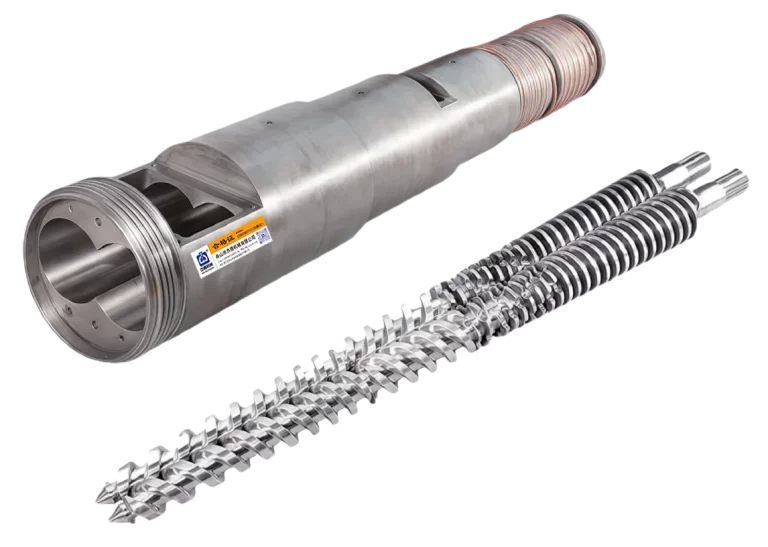
Severe wear on the blow molding screw and barrel prevents uniform melting of the raw material.
Poor mold cooling water causes large temperature deviations in the mold.
Poor mold venting causes air to accumulate inside the mold cavity, leading to scorched material.
III. Surface Bubbles
Gas trapped during the formation of the product surface during blow molding results in surface defects.
The blow molding material is damp, and water vapor evaporates and enters the material surface.
Clogged or poor mold venting prevents gas from escaping smoothly.
The blow molding cycle time is too short, preventing rapid gas removal from the cavity.
Incorrect machine air pressure parameter settings.
Blow molding screw rotating too fast.
Screw back pressure too low.
Raw materials contain volatile additives.
Multi-layer blow molding machine equipment
IV. Low product surface finish
Insufficient blow molding pressure; raw materials not fully compacted.
Barrel temperature too low; raw materials not fully melted, resulting in low surface finish.
Insufficient venting at the mold temperature; product cannot adhere to the inner surface of the mold, causing problems during production.
Some moisture in the raw material; poor flowability during blow molding also reduces surface finish.
V. Uneven longitudinal wall thickness of products
Severe preform sagging due to its own weight. Lowering the preform melt temperature, increasing the preform extrusion speed, using a resin with a lower melt flow rate, and adjusting the preform control device can improve this problem.
The difference in diameter between the two longitudinal cross sections of the blow-molded product is too large, which affects production. To solve this problem, the product design can be appropriately modified to adopt bottom blowing molding.
Newsletter Updates
Enter your email address below and subscribe to our newsletter